


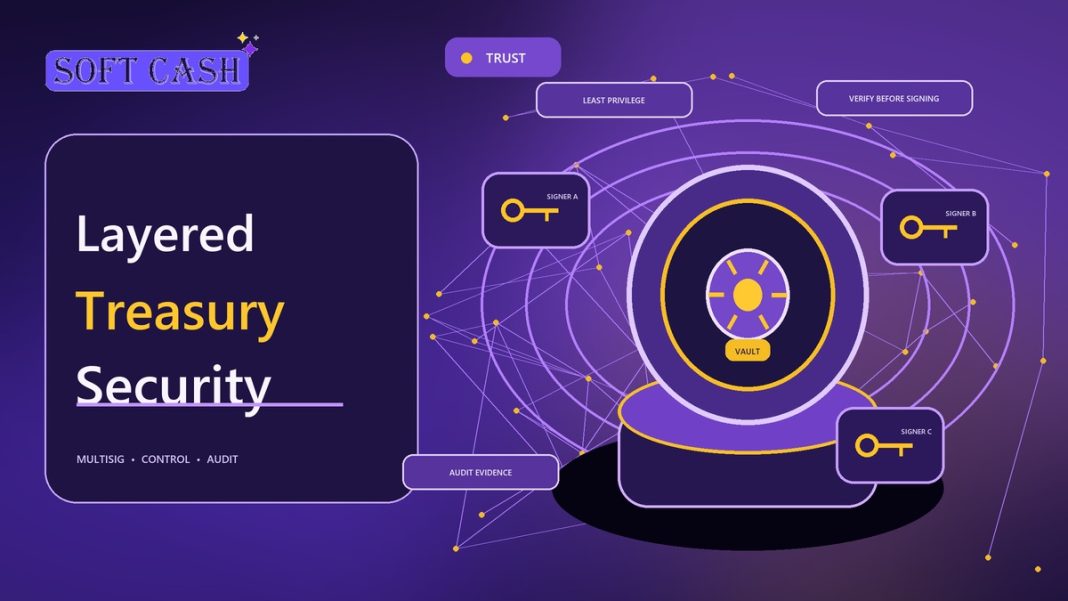
Wallet and treasury security at Soft Cash Finance is based on layered control: separate critical responsibilities, restrict signing authority, protect key material, verify transactions before execution, and preserve evidence for review. The goal is not to claim that risk disappears, but to reduce single points of failure and make sensitive actions controlled, visible, and auditable.
Some elements are confirmed requirements, while others are recommended safeguards or still depend on final production configuration. That distinction is essential when discussing security honestly.
The foundation: no single point of control
A treasury can hold or direct assets that support operations, rewards, liquidity, or other approved ecosystem purposes. Because one compromised credential could create serious harm, the governing requirement is that the development or treasury wallet use multisignature control rather than depend on one ordinary key.
Multisignature control requires an approved threshold of signers before a transaction can proceed. It does not make a wallet immune to compromise, but it can prevent one lost, stolen, or misused key from acting alone. The exact production custody arrangement and signing method remain subject to final configuration, so Soft Cash Finance should not publish an unsupported signer count, vendor, device model, or custody provider.
This principle works with separation of duties. The person who proposes a high-risk action should not automatically have unlimited authority to approve and execute it. Where practical, sensitive actions require distinct roles, a recorded reason, step-up authentication, and durable audit evidence.
Least privilege limits the blast radius
Least privilege means giving each operator, service, or signing role only the access needed for its current task. A routine operational signer should not receive every treasury, contract, configuration, or administrative permission.
- Scoped permissions: access is granted by named capability, resource, or approval threshold—not by whether a menu happens to be visible.
- Approval boundaries: higher-risk actions can require stronger review than ordinary operations.
- Environment separation: development, integration, staging, production, and recovery systems should not share unrestricted credentials.
- Revocation and rotation: credentials and integration access should be replaceable when roles change or risk is detected.
These controls reduce the potential impact of an account takeover or operational mistake. They also help investigators understand which identity initiated, reviewed, approved, or executed an action.
Key material must remain secret
Private keys, seed phrases, and signing material must never appear in application logs, source control, support tickets, analytics, or client responses. They should not be requested through chat, direct messages, email, or unofficial support channels either.
Hardware-backed keys are a recommended safeguard because they can keep signing material away from general-purpose software environments. Monitored key rotation is also recommended, but rotation must be governed carefully: changing a signer should preserve approvals and evidence rather than create an untracked path around existing controls.
Users have a role in this security boundary too. Never share a wallet seed phrase, private key, password, recovery credential, or transaction PIN with someone claiming to represent Soft Cash Finance. Confirm destinations and transaction details through official tools before signing.
Transactions should be checked before they move
A secure signing process evaluates what a proposed transaction will do before approval. Recommended controls include transaction simulation, destination allowlists, transaction limits, and monitoring for unusual activity. These safeguards can help expose an unexpected contract call, incorrect recipient, excessive amount, or permission change before execution.
Allowlists and limits must be governed rather than treated as invisible guarantees. They can reduce risk, but they cannot replace signer judgment, contract review, or monitoring. The exact production thresholds, emergency controls, and confirmation policy should be announced only when they are approved and active.
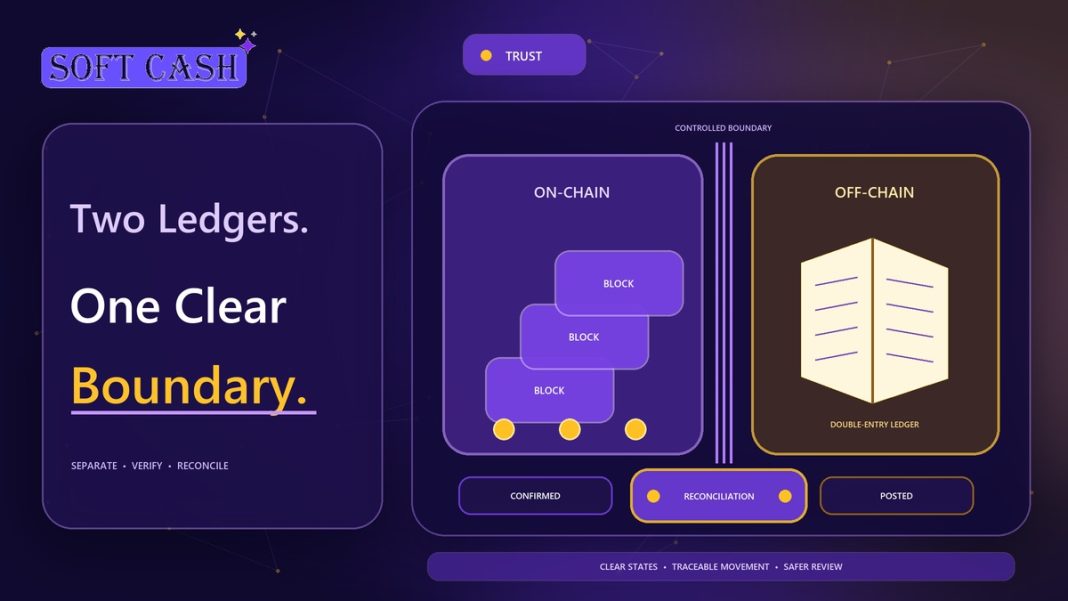
Readers can also review how the on-chain SOFT Wallet differs from internal platform accounting. Keeping those systems distinct prevents a pending or approved internal reward from being misrepresented as an on-chain holding.
Auditability after approval
Security continues after a transaction is signed. Contract changes, tax or limit changes, ownership transfers, and emergency actions should emit on-chain events and internal alerts. High-impact changes should use a delay or timelock if that control is approved for the final configuration.
Internal financial and administrative actions should also retain the actor, reason, time, status, and relevant before-and-after evidence. Corrections should use traceable compensating entries rather than quietly rewriting financial history. This supports reconciliation between internal workflows and confirmed chain activity.
For a broader explanation, see how Soft Cash Finance works to keep reward transactions auditable. Audit records do not prevent every incident, but they make unauthorized or mistaken activity harder to hide and easier to investigate.
What these principles do—and do not—promise
Multisignature approval, least privilege, hardware-backed keys, simulation, allowlists, limits, alerts, rotation, and timelocks are defense layers. No individual layer guarantees safety, and public content should not claim that a wallet, treasury, contract, or blockchain transaction is risk-free.
Blockchain participation can involve key compromise, malicious contracts, operational error, network disruption, reorganization, liquidity risk, and changing regulatory obligations. Users should verify official destinations and current notices, review transaction details, and keep their own credentials private.
Key takeaways
- Treasury control is designed to avoid dependence on one ordinary key.
- Multisignature control and least privilege reduce single-person and over-permission risk.
- Secret signing material must stay out of logs, source control, tickets, and messages.
- Simulation, allowlists, limits, monitoring, and rotation are recommended defense layers.
- High-risk actions need approvals and evidence; security controls reduce risk but cannot eliminate it.
Frequently asked questions
Does Soft Cash Finance use a multisignature treasury?
The governing security requirement is that the development or treasury wallet must be multisignature. The exact production signer threshold, custody arrangement, and signing method should be confirmed only through current official information.
Are hardware wallets a confirmed production detail?
Hardware-backed keys are recommended security practice, but public information should not invent a particular device, provider, or final custody setup.
Can an administrator bypass treasury controls?
High-risk authority should not bypass ledger, audit, or security integrity. Sensitive actions should use scoped permissions, approvals, recorded reasons, and audit evidence.
What should I do if someone asks for my seed phrase?
Do not share it. A seed phrase or private key can control wallet assets. Stop the interaction and verify the situation through official Soft Cash Finance channels.
Where can I check current security information?
Visit the official Soft Cash Finance website for current notices, approved links, and production details before acting on wallet or treasury information.