

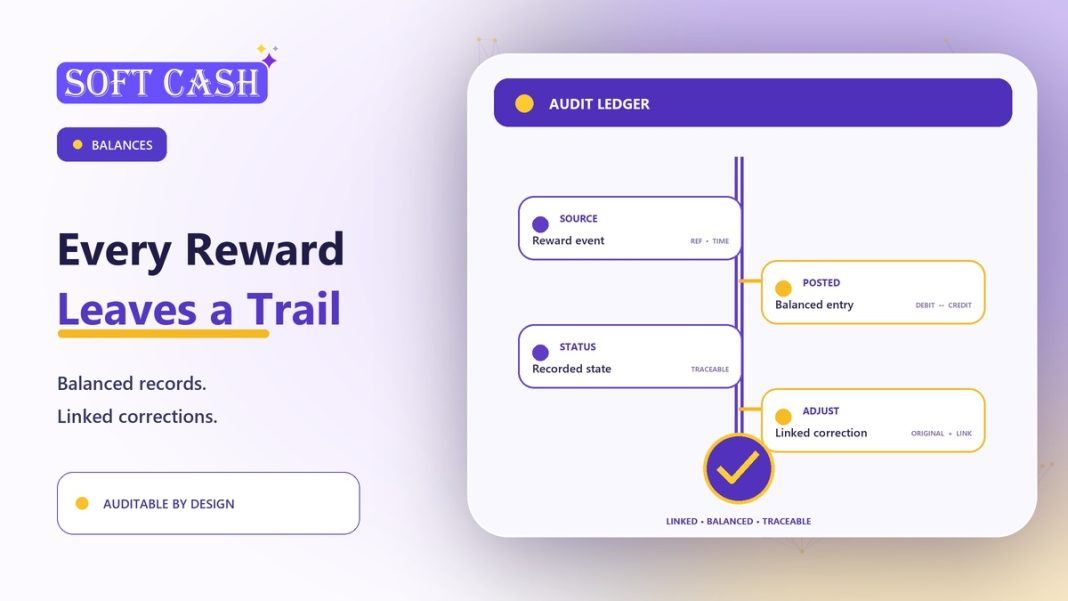
Soft Cash Finance keeps reward transactions auditable by recording them in an internal, off-chain double-entry ledger with traceable statuses, references, and history. Every internal value movement must balance debits and credits in one atomic posting, while corrections are made through linked compensating entries instead of silently editing a balance.
This design makes a reward easier to follow from its source and eligibility checks to its pending, approved, reversed, or other recorded state. Auditability supports accountability, but it does not guarantee that every activity qualifies, that every transaction is instant, or that an internal Reward Center entry is already on-chain.
Auditability starts with the Reward Center ledger
The Reward Center is Soft Cash Finance’s internal, off-chain accounting system for Pending Rewards and approved Reward Balance. It is separate from the on-chain SOFT Wallet. That boundary matters because an auditable internal ledger entry and a confirmed blockchain transaction are different kinds of records.
Inside the Reward Center, the system follows double-entry accounting. A movement of internal value is posted with balancing debit and credit entries rather than by changing one number without context. The recorded entries create a trail that can be reconciled: where value came from, where it went, and which event caused the movement.
For a fuller explanation of this balance model, read what the Reward Center is and how its internal ledger works. To compare internal rewards with blockchain holdings, see SOFT Wallet vs Reward Center.
What a traceable reward record needs
A useful audit trail is more than a total balance. Reward activity is tied to the relevant user, event, rule, status, and time. Depending on the transaction type, a record can include the reward source, amount, reference, timestamps, eligibility result, approval state, and related entries. Financial confirmations are designed to show important details such as amount, fee, net amount, destination, network, status, timestamp, and reference where those fields apply.
Not every reward uses every field. A mission credit, referral-related entry, internal gift, wallet transfer, and blockchain transaction have different contexts. The principle is consistent: a reviewer should be able to connect the balance movement to the event and rule that produced it rather than relying on an unexplained total.
Status history shows where a transaction stands
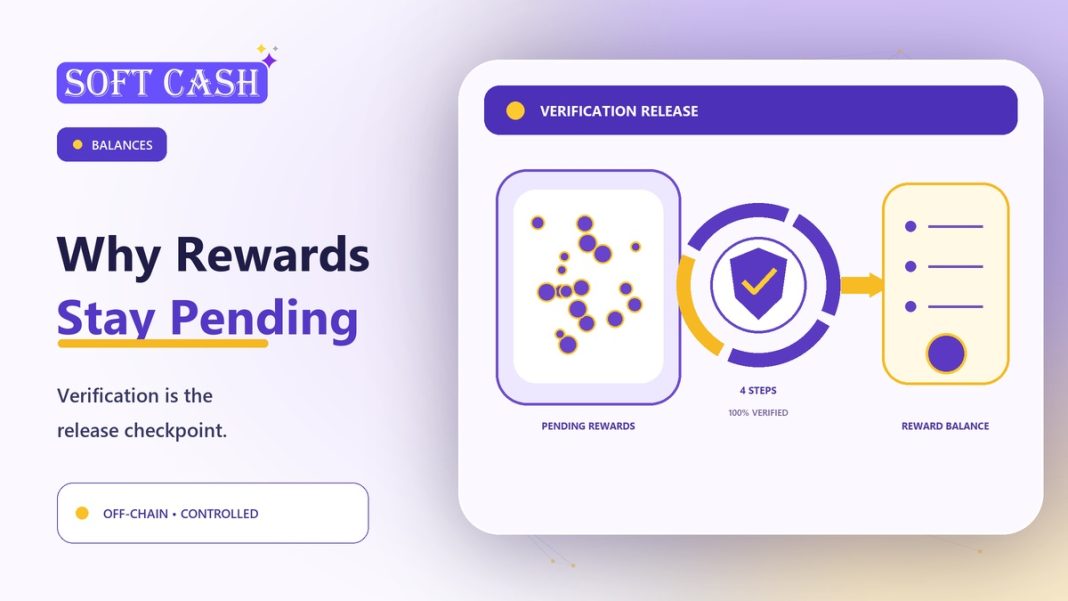
Soft Cash Finance separates transaction states so that a record can show what has happened without pretending that an unfinished action is complete. A reward may first appear in Pending Rewards while verification or another required control remains incomplete. When the confirmed release rule is met, it can move to approved Reward Balance through recorded ledger activity.
Other workflows can use states such as pending review, approved, processing, completed or credited, rejected, expired, or reversed when those states fit the feature. A reversal is not a deletion of history. It is a linked compensating correction with its own audit record. This preserves the original event and the action that corrected it.
For the verification-related release path, read why rewards stay pending until a profile is verified and how Pending Rewards differ from approved Reward Balance.
Why balances are not edited silently
Directly overwriting a financial balance would make it difficult to understand why the number changed. Soft Cash Finance’s ledger rules instead require corrections through linked compensating entries. The correction can offset an earlier posting while keeping both records available for reconciliation.
Administrative actions affecting material records also require accountability. The governing design calls for actor, reason, time, before-and-after values, and an audit record for authorized changes. Material histories are append-only or corrected through linked adjustments, and administrator actions are intended to be tamper-evident and exportable according to permission.
These controls help operations teams investigate errors, fraud signals, disputes, and reconciliation differences. Access remains permission-based; auditability does not mean that every internal record or another user’s private information is publicly visible.
How on-chain and off-chain records connect
The SOFT Wallet represents on-chain BEP-20 activity, while the Reward Center records internal platform rewards. The two balances are never merged. A chain event is not treated as a Reward Center ledger posting until the configured blockchain finality policy is satisfied, helping prevent an unconfirmed network event from being presented as settled internal value.
Users should check the correct record for the action they performed. For an internal reward, review the Reward Center status and reference. For an on-chain transfer, review the wallet confirmation and the relevant blockchain transaction details. A screenshot or message from an individual is not a substitute for the official account record or blockchain evidence.
What users can do when a record looks wrong
- Identify the system. Confirm whether the activity belongs to the Reward Center or the SOFT Wallet.
- Check the status. Pending, processing, completed, rejected, expired, and reversed do not mean the same thing.
- Save the reference. Keep the displayed transaction reference, amount, time, and relevant activity details.
- Use official support. Report the exact reference and discrepancy through an official channel so the record can be investigated.
- Protect credentials. Never disclose your password, six-digit Access/Transaction PIN, private key, or seed phrase to someone claiming they can alter a ledger entry.
Key takeaways
- Reward Center activity is recorded in an internal off-chain double-entry ledger.
- Each internal movement balances debits and credits in one atomic posting.
- Statuses, timestamps, references, and linked events make transactions traceable.
- Corrections use linked compensating entries rather than silent balance edits.
- Internal Reward Center records remain separate from confirmed on-chain SOFT Wallet activity.
Frequently asked questions
Does auditable mean every reward is visible on the blockchain?
No. Reward Center records are off-chain internal ledger entries. Only confirmed SOFT Wallet transactions are presented as on-chain activity.
Can Soft Cash Finance simply edit a user’s balance?
The governing ledger rule says balances are not directly edited. Corrections use linked compensating entries so the original posting and its adjustment remain traceable.
What helps identify a specific reward transaction?
The relevant record may include its source, amount, status, timestamp, reference, eligibility result, and linked entries. Fields vary by transaction type.
Does an audit trail guarantee that a reward will be approved?
No. Auditability records what happened. Approval still depends on the applicable eligibility, verification, timing, anti-abuse, and review rules.
What should I provide when asking support about a transaction?
Provide the official transaction reference, amount, displayed status, time, and the activity involved. Never send passwords, PINs, private keys, or seed phrases.
For current rules, official account access, and support routes, visit the official Soft Cash Finance website.