



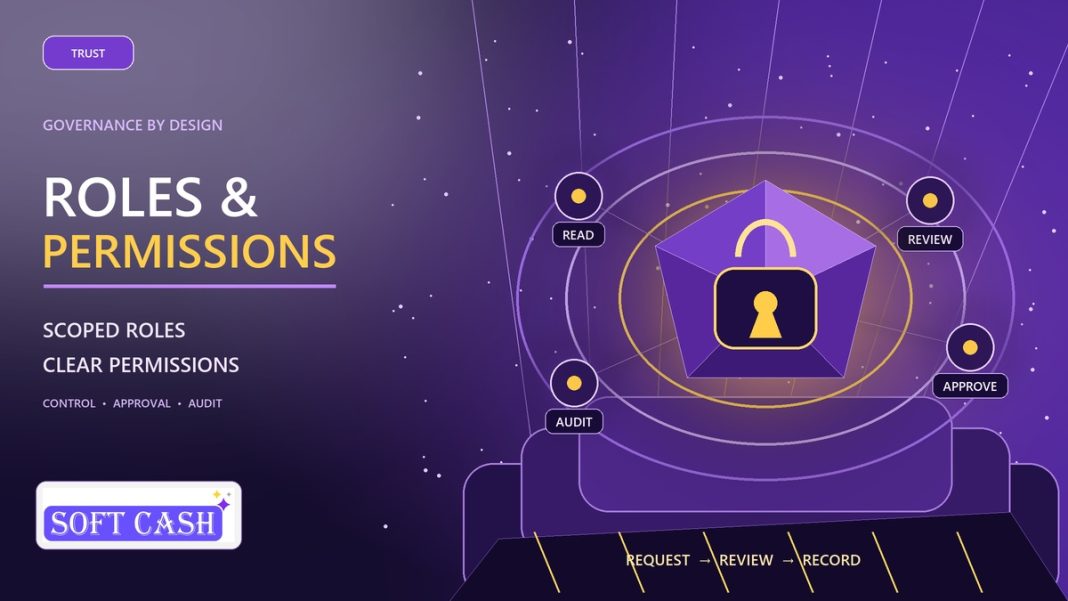
Soft Cash Finance platform governance uses defined roles, scoped permissions, approval controls, and audit records so that access to sensitive functions is deliberate rather than assumed. A person should be able to perform only the actions explicitly assigned to that role, while high-risk actions require stronger checks and leave reviewable evidence.
This model is commonly described as role-based access control, or RBAC. Its purpose is not to make every role equally powerful; it is to give each role the access needed for a specific responsibility without granting unnecessary authority across the platform.
Roles define responsibility, not unlimited access
Soft Cash Finance covers many operational areas, including users, verification, rewards, missions, balances, withdrawals, referrals, creators, advertising, content, managers, configuration, and reporting. Treating all administrative access as one broad permission would create unnecessary security and accountability risks.
Instead, the governance model separates responsibilities into defined roles. A user controls permitted parts of their own profile and activity. A manager works within approved sales-partnership functions and assigned limits. A reviewer or agent handles assigned cases or exceptions. An administrator receives scoped operational or configuration access. Super Admin or owner authority covers governance at the highest level, but it remains subject to ledger, audit, and security integrity.
These descriptions explain the governance structure; they do not publish a complete production permission matrix. Exact assignments and resource limits must remain governed, recorded, and adjusted only through authorized processes.
Permissions are explicit, scoped, and server-enforced
A role name alone is not enough. Soft Cash Finance is designed to implement access through named permission scopes, potentially combined with resource constraints and approval thresholds. Examples include the ability to read a user record, review an identity-verification case, propose a configuration change, approve a withdrawal at a defined tier, publish a campaign, assign a role, or read audit evidence.
The important principle is that seeing a menu or button does not create authority. Navigation may hide or reveal features for usability, but authorization decisions remain server-side. The system must check the acting identity, permission scope, relevant resource, and any required threshold before accepting an action.
- Deny by default: access is not available unless it has been explicitly granted.
- Least privilege: each role receives only the access needed for its assigned work.
- Object-level checks: permission to work on one case or resource does not automatically grant access to every case.
- Server-side decisions: the interface cannot authorize financial, verification, reward, or rule actions by itself.
High-risk actions require stronger governance
Some actions can affect user access, identity status, rewards, balances, withdrawals, configurations, or platform-wide rules. For these actions, a simple logged-in session is not sufficient governance. The platform design calls for a recorded reason, step-up authentication, separation of duties where practical, and immutable audit evidence.
Separation of duties means that one person should not always be able to request, approve, and conceal a sensitive action alone. For example, proposing a material configuration change and approving it can be treated as distinct permissions. Approval thresholds can add another boundary when an action exceeds a governed level.
Owner authority is also accountable. The highest role is not intended to bypass the internal ledger, delete audit history, or ignore security controls. This protects both users and the integrity of the platform’s decision process.
Audit records make authority reviewable
Permissions answer who may attempt an action; audit records show what actually happened. Material administrative and financial actions should record the actor, reason, time, outcome, and before-and-after state where applicable. Those records are designed to be append-only and tamper-evident.
Corrections should therefore use linked, traceable adjustments instead of erasing history. This principle is especially important for reward decisions, balance adjustments, withdrawal outcomes, account restrictions, and configuration changes. It creates evidence for investigation, reconciliation, support, and oversight.
Governance records also connect to the platform’s rule lifecycle. A configurable rule moves through Draft, Review, Approved, Scheduled, Active, and Superseded or Cancelled states. Learn how Soft Cash Finance governs rule changes and why reward and fee changes are published.
What this means for users
Users do not need to memorize technical permission names, but they should expect sensitive decisions to be controlled and explainable. A support role should not automatically receive broad financial authority. A manager’s commercial functions should remain within assigned rank and permission. A reviewer should work only on assigned cases, and private user data should be accessible only within explicit scopes.
Role-based controls reduce unnecessary access, but no security model eliminates all risk. Credentials can be compromised, permissions can be misconfigured, and authorized staff can misuse access. Monitoring, additional authentication, testing, backups, fraud controls, and regular permission review remain necessary. For related safeguards, see how Soft Cash Finance approaches data and account security.
Key takeaways
- Soft Cash Finance distributes authority across defined roles instead of relying on one undifferentiated access point.
- Permissions are explicit, scoped, deny-by-default, and enforced on the server rather than inferred from visible interface elements.
- High-risk actions require stronger controls such as a recorded reason, additional authentication, approval boundaries, and separation of duties where practical.
- Material actions leave append-only, reviewable audit evidence; corrections should not erase history.
- Super Admin or owner authority remains accountable to ledger, audit, and security integrity.
Frequently asked questions
What is role-based access control?
Role-based access control assigns explicit permissions to defined roles. It helps ensure that a person can perform the work assigned to that role without automatically receiving unrelated or platform-wide authority.
Does seeing an admin feature mean someone can use it?
No. Interface visibility is not authorization. Sensitive actions must be checked server-side against the acting identity, permission scope, resource constraints, and any required approval threshold.
Can the owner bypass audit and ledger controls?
No. The governance model states that owner authority is not a bypass around ledger, audit, or security integrity. High-level authority remains recorded and accountable.
Why are some actions split between requester and approver?
Separating duties reduces the chance that one account can initiate and complete a high-risk action without independent review. It also creates clearer accountability when an exception or dispute is investigated.
Where can I check current Soft Cash Finance information?
Visit the official Soft Cash Finance website for current platform information, announcements, and applicable terms before acting.