

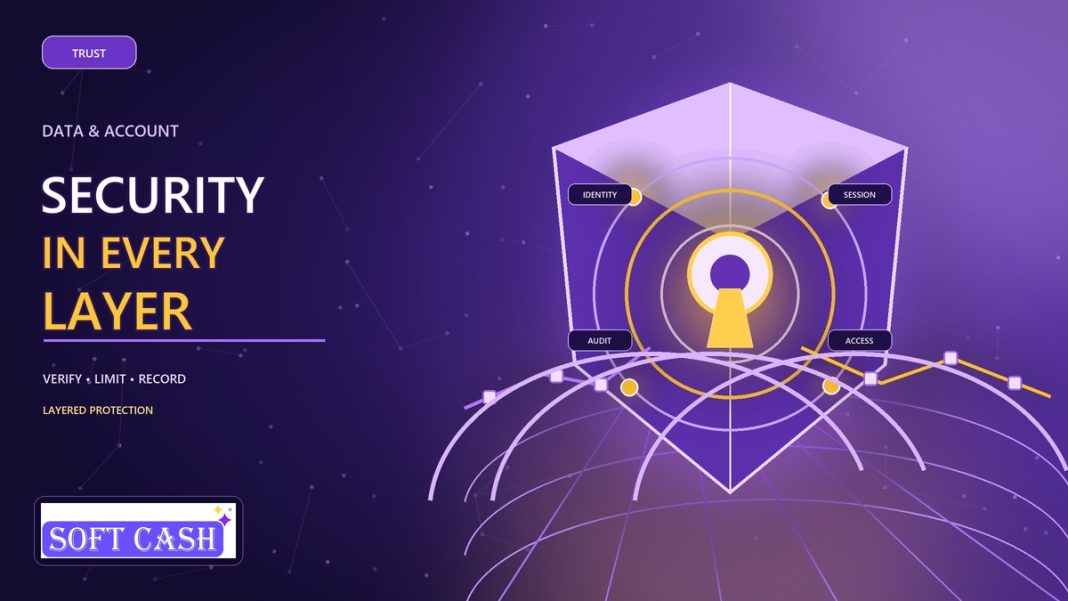
Soft Cash Finance protects user data and accounts through layered controls around identity, authentication, sessions, permissions, sensitive actions, and audit records. Security is shared: the platform must enforce controls on the server, while users must protect their passwords, PINs, authenticator access, and wallet recovery information.
No online or blockchain system can promise zero risk. The practical goal is to reduce preventable exposure, detect suspicious behavior, limit what a compromised account can do, and keep a reviewable history when something needs investigation.
Account protection starts with verified identity
Registration uses an email verification code before a user creates a username, login password, and separate six-digit Access/Transaction PIN. Profile completion can add a verified mobile number and government photo-ID information as part of the four-step verification process. Email, mobile number, and government photo-ID number are subject to one-person-one-account uniqueness controls.
These checks support account integrity and anti-abuse review, but they do not make identity data public. Verification evidence and sensitive account information should be available only to authorized roles for a legitimate task. The exact third-party KYC provider and final privacy-retention policy remain governed decisions, so users should consult current official notices before submitting information.
Different secrets protect different actions
A login password and an Access/Transaction PIN serve different purposes. Passwords authenticate account access; the PIN provides a separate check for sensitive flows. The security design calls for passwords to use salted adaptive hashing rather than reversible storage, while the PIN is validated through a server-side hash with attempt lockout.
Email or mobile verification codes should be single-use, purpose-bound, short-lived, attempt-limited, and stored in protected form. Password and PIN resets use an email code. After a sensitive reset, active sessions should be revoked so an older session cannot simply continue unchanged.
Google Authenticator-based time codes can add another factor. Biometrics, where supported, are limited to unlocking on the user’s device; biometric templates are not transmitted to Soft Cash Finance. Users should never send a password, PIN, recovery code, private key, or seed phrase to anyone claiming to provide support.
Sessions are limited, revocable, and visible
Soft Cash Finance’s current account settings specify an automatic lock after 15 minutes of inactivity and automatic logout after 60 minutes of inactivity. The broader session model includes rotating refresh tokens, revocation, device history, and inactivity and absolute expiry controls.
These measures help narrow the useful life of an unattended or stolen session. They do not replace basic precautions: sign out on shared devices, keep the operating system and browser updated, use a unique password, and review unexpected device or security activity promptly.
Sensitive actions receive stronger checks
Withdrawal and security-setting changes require step-up authentication. Access, withdrawal, or internal transfer may also be held or blocked by policy, with a recorded reason, history, and support or appeal path. This extra friction is intentional because changing security settings or moving value carries more risk than reading a public page.
Eligibility, authorization, balances, financial calculations, rewards, and rule evaluation remain server-side. A visible button or hidden menu is not permission. Role-based access controls use named scopes and resource limits, and high-risk administrative actions require a reason, stronger authentication, separation of duties where practical, and tamper-evident audit evidence.
For a broader view of anti-abuse controls, read Soft Cash Finance’s approach to fraud prevention. The distinction between internal records and blockchain holdings is covered in the on-chain and off-chain balance safety guide.
Data protection extends beyond the login screen
At the edge and API layers, the architecture calls for encrypted transport, authenticated requests, rate limits, payload limits, request identifiers, scoped integration credentials, signature checks, rotation, and revocation. Production access follows least privilege, while test environments use sanitized rather than live personal data.
Security records cover sessions, devices, verification cases, risk cases, support activity, integrations, and administrator actions. Material financial, reward, approval, and audit evidence should not be silently deleted; corrections and changes preserve history. This supports investigation without suggesting that every internal record is open to the public.
Account safety also depends on separating responsibilities. The on-chain SOFT Wallet and the off-chain Reward Center are distinct systems, and confirmed blockchain holdings are not merged with internal reward balances. This limits ambiguity during review and reconciliation. See why reward decisions are designed to be auditable.
Key takeaways
- Identity checks, separate secrets, session controls, permissions, and audit records work as complementary layers.
- Sensitive changes and value movement require stronger server-side checks than ordinary browsing.
- Biometrics stay at the device level; passwords, PINs, recovery codes, private keys, and seed phrases must never be shared.
- Private evidence remains access-controlled even when decisions and administrator actions are auditable.
- No digital platform is risk-free, so users should verify official links and respond quickly to suspicious activity.
Frequently asked questions
Does Soft Cash Finance store my password in readable form?
The security design requires salted adaptive password hashing, not reversible password storage. Login and reset attempts should also be rate-limited.
What is the Access/Transaction PIN?
It is a separate six-digit numeric secret for sensitive flows. It should not be reused as a password or shared with another person.
Does biometric login send my fingerprint or face data to the platform?
No. Supported biometrics are intended only for device-level unlock, and biometric templates are not transmitted.
Why can a withdrawal or security change require another check?
Step-up authentication helps confirm that the person controlling the current session is authorized to perform a higher-risk action. A hold can also create time for policy or risk review.
Where should I confirm current security instructions?
Use only official links and visit the official Soft Cash Finance website for current security, verification, and support information.