


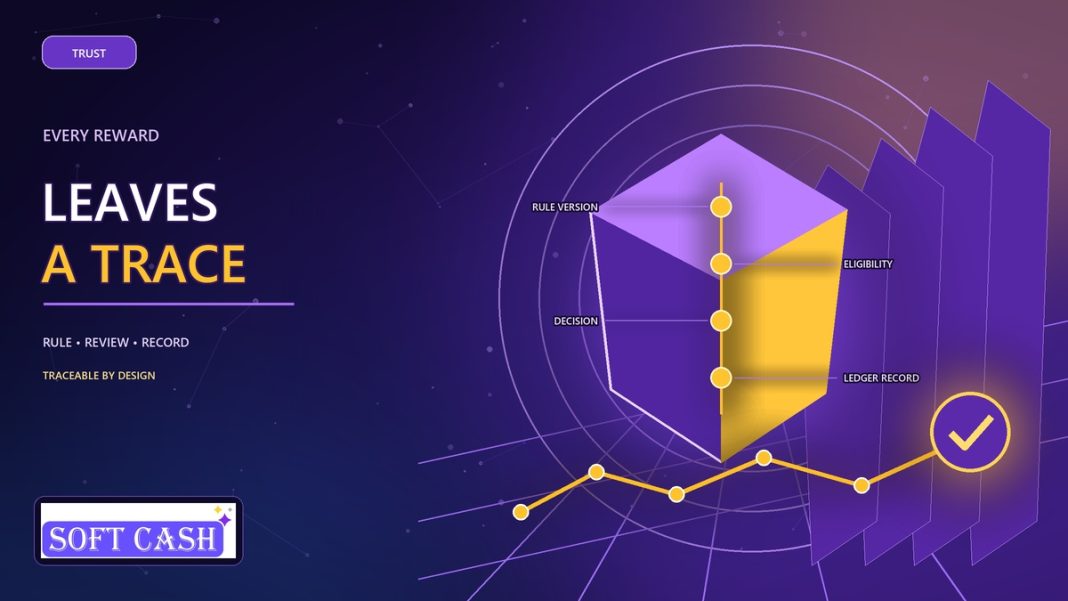
Every Soft Cash Finance reward decision is designed to leave a reviewable record: the applicable rule, the user or event involved, the eligibility result, the decision state, and any resulting ledger movement. This audit trail helps the platform explain outcomes, prevent duplicate credits, investigate exceptions, and correct errors without silently rewriting financial history.
Auditable does not mean that every reward is automatically approved or that private records are publicly visible. It means authorized reviewers can trace how a result was produced while access to sensitive evidence remains controlled.
What an auditable reward decision contains
A useful audit record answers practical questions. Which rule version applied? What event triggered the review? Was the user eligible within the correct time window? Did verification, caps, budget, or fraud controls affect the result? Who or what approved, held, rejected, or reversed it?
Soft Cash Finance treats reward logic as a server-side responsibility rather than trusting a button, timer, or value displayed by a browser. Mission events carry identifiers, an actor, a source, event and receipt times, structured attributes, a schema version, and a deduplication key. These details let the system connect a visible outcome to the event that produced it.
The platform’s audit model covers more than mission claims. It also supports referral qualification, reward liabilities, staking activity, transfers, withdrawals, advertising, creator review, manager sales, support, security events, and financial reconciliation.
Rule versions preserve the decision context
Rewards can be governed by eligibility rules, activity windows, verification requirements, limits, budgets, claim behavior, and fraud controls. Some values are configurable, so the system must know which approved rule version was active when an event occurred. A later change should not silently alter the historical basis of an earlier decision.
The governed activation lifecycle moves a rule through draft, review, approval, scheduling, activation, and eventual supersession or cancellation. An active cycle snapshots the version it used. That makes a review about the facts and rules that applied at the time, not whatever configuration happens to be live today.
Duplicate protection keeps one event from becoming two rewards
Retries are normal in digital systems. A slow connection, repeated tap, webhook replay, or background job retry can submit the same event more than once. Without duplicate protection, a technically valid retry could create an extra credit.
Soft Cash Finance uses event and idempotency keys so a repeated request returns the original result instead of producing another reward. Mission events, ledger postings, referral edges, and blockchain events also have uniqueness controls appropriate to their source. This is one reason auditable event identity matters: it supports both fairness and financial accuracy.
Related controls are explained in Soft Cash Finance’s approach to fraud prevention.
Ledger records separate decisions from balance changes
A reward decision and a balance movement are related, but they are not the same record. The Reward Center is an internal off-chain double-entry ledger for pending and approved rewards, while the SOFT Wallet represents confirmed on-chain holdings. Readers can compare them in the guide to on-chain and off-chain balance separation.
Every internal value movement must balance debits and credits in one atomic posting. Balances are not directly edited. If a posted item needs correction, the governed method is a linked compensating entry that preserves the original history and records the adjustment. Reconciliation then compares internal workflow, provider or payment state where relevant, and blockchain state; exceptions enter a review queue.
This structure makes it possible to distinguish a pending reward, an approved decision, a posted credit, a hold, and a later correction. For a deeper explanation of these states, see how rewards move from pending to approved.
Human and administrative actions need evidence too
Automation does not remove the need for human review. Fraud signals, exceptional cases, high-risk actions, and some financial workflows may require an authorized reviewer. Those actions are governed by role-based permissions rather than by whether a menu is visible on screen.
High-risk actions require a recorded reason, step-up authentication, and separation of duties where practical. Administrator actions must remain tamper-evident and exportable according to permission. Withdrawal and transfer decisions create history showing the user, amount, status, responsible actor, and execution time. Sensitive exports and private evidence remain access-controlled; auditability is not permission for unrestricted disclosure.
Key takeaways
- Reward outcomes are tied to identifiable events, rule versions, eligibility checks, and decision states.
- Deduplication and idempotency help prevent retries from creating duplicate credits.
- Reward decisions are distinct from ledger postings and on-chain confirmations.
- Corrections use linked compensating entries instead of erasing or directly editing financial history.
- Auditable records support review and accountability, but they do not guarantee approval or make private evidence public.
Frequently asked questions
Does auditable mean every reward is guaranteed?
No. A reward can remain pending, require verification, be held for review, expire under an applicable rule, or be rejected with a recorded reason. Auditability explains the path to the outcome; it does not promise approval, income, or token value.
Can the same activity be credited twice after a retry?
The system is designed to use deduplication and idempotency keys so repeated submissions return the original result rather than creating another credit. Suspected exceptions can be reviewed against the event and ledger history.
Can an administrator simply edit a user’s balance?
The governed ledger model does not allow direct balance editing. A correction should be made through a linked compensating entry, preserving both the original posting and the reasoned adjustment.
Are audit records visible to everyone?
No. Users should receive meaningful statuses, criteria, and notices relevant to their own activity, while privileged evidence and exports are protected by scoped permissions and privacy controls.
Where can I check current reward rules?
Reward settings can change through governed configuration and official announcement. Visit the official Soft Cash Finance website for current information before making a decision.