


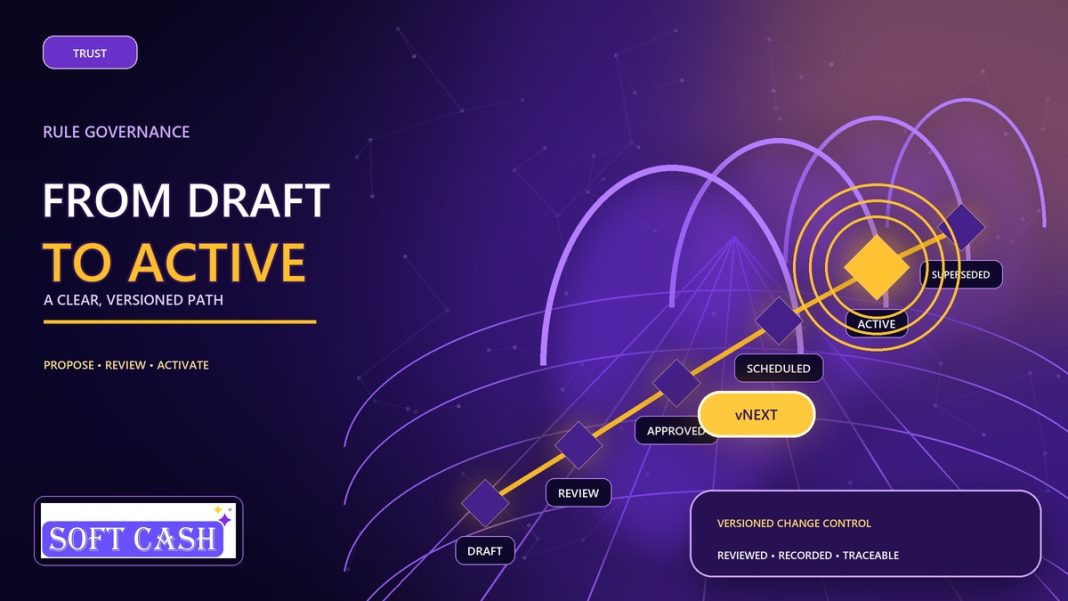
Soft Cash Finance governs rule changes through a defined lifecycle: Draft → Review → Approved → Scheduled → Active → Superseded/Cancelled. A proposal does not become a live platform rule merely because it appears in a document, interface, or discussion; it must pass the relevant checks, receive approval, and reach its scheduled activation point.
When a rule becomes active, the platform records the version used by the applicable cycle or decision. This makes changes traceable and helps prevent configurable values from being altered silently.
Why rule governance matters
Soft Cash Finance includes configurable systems for rewards, missions, fees, staking, eligibility, limits, and other operational parameters. Those settings may need to change as funding, security, fraud patterns, product capacity, or policy requirements change. Flexibility is useful only when users and administrators can tell which version applied at a particular time.
A governed lifecycle separates an idea from an enforceable rule. It also creates checkpoints for review, testing, communication, scheduling, and rollback planning. The purpose is not to suggest that every parameter will stay unchanged. It is to make changes deliberate, authorized, announced where material, and recoverable through records.
The six states from draft to retirement
1. Draft
A draft is a proposed rule or revision. It can be edited and evaluated, but it is not a live instruction for users or the production system. Prototype figures, planned titles, mockups, and older documents must not be treated as current values simply because they exist.
2. Review
During review, the proposal can be checked for product logic, funding, security, compliance implications, user impact, technical feasibility, and conflicts with higher-authority decisions. For rewards, governance requires a defined purpose, funding source, eligibility rule, cap, and audit trail before an offer is presented as active.
3. Approved
Approval confirms that the proposed version is authorized to proceed. Approval is still distinct from activation: a rule may require implementation, testing, communication, or a future effective time before it can govern a live decision.
4. Scheduled
A scheduled rule has an intended activation point. Scheduling helps coordinate system configuration, public notices, support guidance, and operational readiness. It also reduces ambiguity between an approved future change and the version that remains active today.
5. Active
The active version is the one the server uses for relevant eligibility, calculations, limits, and decisions. Clients display information, but they do not define authority. Each active cycle should snapshot the rule version it used so a later review can reconstruct the decision context.
6. Superseded or cancelled
A newer approved version may supersede an older one, while a proposal may be cancelled before activation. The historical record should remain traceable. Supersession does not erase the fact that an earlier version governed earlier events, and corrections should use linked, reviewable adjustments rather than silently rewriting history.
What a versioned rule record should preserve
A useful rule record links the rule identity and version to its status, authorized change, activation timing, and the decisions or cycles that used it. Material administrative changes and financial outcomes should also create tamper-evident audit entries with the actor, reason, time, and before-and-after state where applicable.
- Rule identity and version: which governed instruction was evaluated.
- Lifecycle status: whether it was draft, reviewed, approved, scheduled, active, superseded, or cancelled.
- Effective context: when the version began to apply and which cycle or event used it.
- Authorization and reason: who performed a material action and why.
- Preserved history: a traceable path from the earlier state to the current one.
This complements the platform’s broader audit model. Read why reward decisions are designed to be auditable and how account and data controls protect sensitive actions.
How users should read changing values
Users should distinguish current official information from historical examples, drafts, and configurable values. A previously published amount or threshold may be accurate for an earlier period yet no longer be the active rule. The latest owner-authorized written decision and current official announcement take precedence over older drafts where they conflict.
Material changes should be communicated through official channels rather than applied silently. Users should verify current terms before acting, especially for rewards, fees, staking, eligibility, withdrawals, transfers, or time-limited programs. No versioning process removes market, technical, operational, liquidity, or regulatory risk.
The separation of rule decisions from resulting ledger entries also matters. An eligibility decision explains why an outcome occurred; a ledger entry records the associated balance effect. For that distinction, see how on-chain and off-chain balances are separated.
Key takeaways
- A draft is not an active rule.
- Approval and activation are separate lifecycle stages.
- Active cycles snapshot the rule version they use.
- Material changes are versioned, recorded, and announced through official channels rather than applied silently.
- Superseded rules remain part of the historical decision context.
Frequently asked questions
Can a draft rule affect my account?
No. A draft is a proposal, not the active production rule. Live decisions should use the currently active, server-side version.
Why is an approved rule not immediately active?
It may still need implementation, testing, communication, or a scheduled effective point. Keeping approval separate from activation prevents future changes from being confused with current rules.
What happens when a rule is superseded?
The newer active version governs future applicable decisions, while the previous version remains traceable for events that occurred under it.
Are all reward amounts and fees permanent?
No. Many operational values are configurable and may change through governance. Users should check current official information before relying on an amount, fee, limit, or eligibility condition.
Where can I confirm the current active information?
Visit the official Soft Cash Finance website and use official announcements for current rules, effective values, and program status.