


Soft Cash Finance works to keep missions fair by treating mission completion as verified, server-recorded activity rather than trusting a browser timer or a user’s own claim. Its mission design combines identity and eligibility checks, server-derived timing, event deduplication, fraud controls, reward limits, and an audit history so genuine participation can be distinguished from automation or repeated submissions.
Bot-resistant does not mean that abuse is impossible. It means the system is designed to reduce common manipulation paths, preserve evidence, and review activity through governed rules instead of rewarding every client-side signal automatically.
Fair missions start with server-side decisions
The web or mobile interface can show a timer, progress bar, claim button, or visit counter, but those elements are presentation. Eligibility, mission rules, reward calculations, verification, and final outcomes are determined server-side. This separation matters because information reported only by a user’s device can be altered, replayed, or automated.
For the Hourly mission, the 60-minute eligibility window is derived from server time; the visible device timer is a guide rather than the authority. Weekly boundaries also use the platform’s governed server-time cycle. Users should therefore follow the status recorded in the live mission panel instead of changing a device clock or relying on a local countdown.
Each mission has a verifiable rule set
A mission definition is designed to identify who is eligible, which event counts, the target, the active window, dependencies, reward, caps, verification requirements, and whether completion requires a claim or automatic credit. Keeping those fields together helps the platform evaluate the same kind of action consistently.
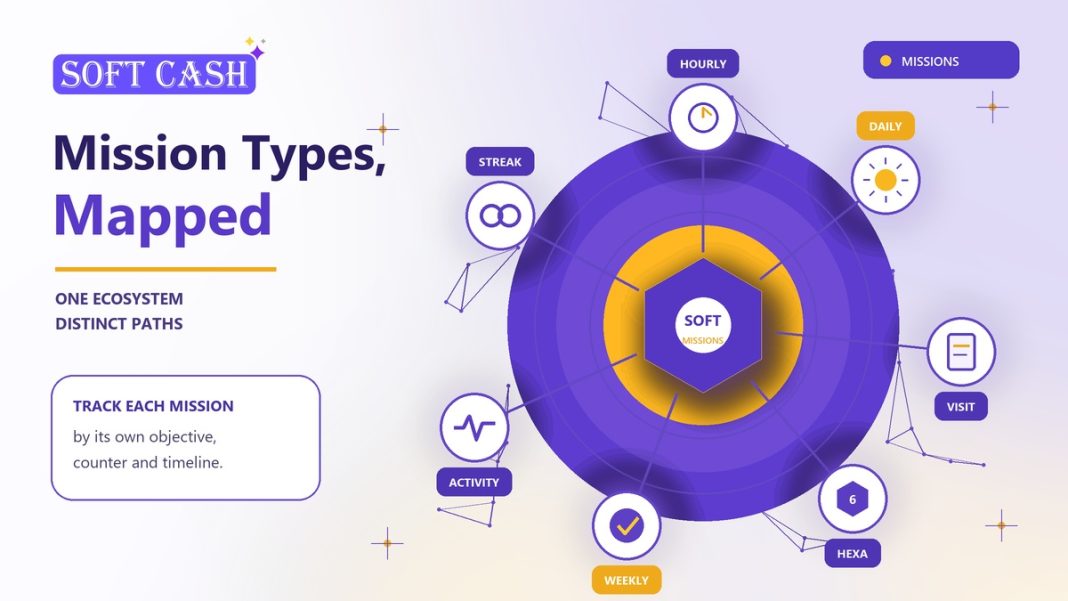
This structure also separates mission types. Verified online activity is not the same evidence as a verified distinct page visit, and neither should be counted simply because a tab is open. The Activity Reward and Visit Task comparison explains why their counters and evidence are distinct. For a wider overview, see the map of Soft Cash Finance mission types.
Duplicate events should not create duplicate rewards
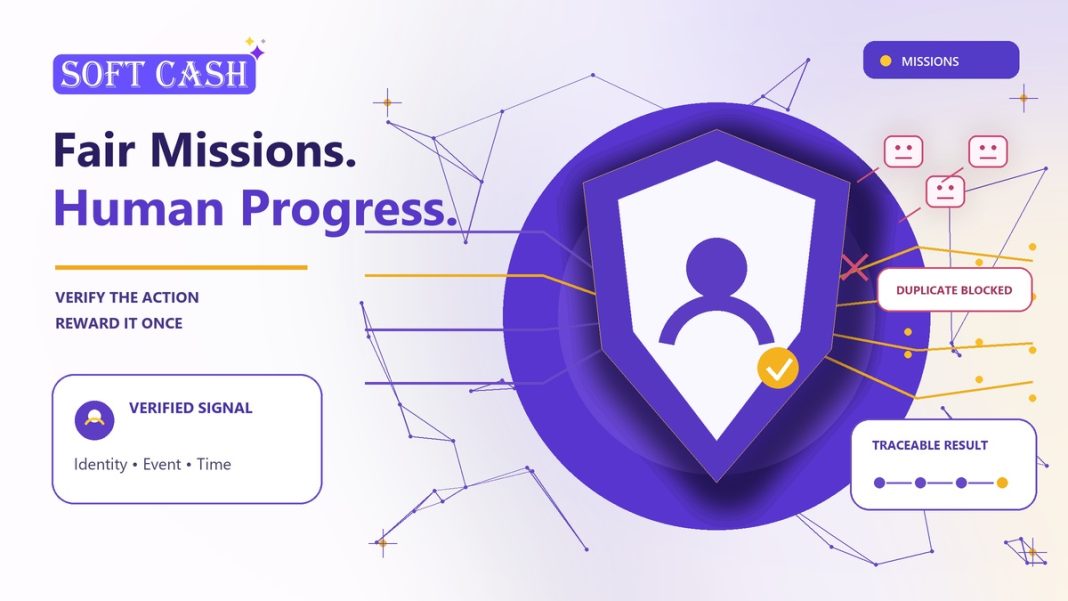
Mission activity is designed around identifiable events. A recorded event carries an event ID, actor, source, occurrence and receipt times, a versioned attribute structure, and a deduplication key. If the same event or idempotency key is submitted again, the intended behavior is to return the original result rather than issue another credit.
This protects the ledger from simple replay attempts, repeated button submissions, connection retries, and other duplicate inputs. It also supports reconciliation: the platform can relate a reward decision to the exact activity and rule version that produced it instead of treating the balance as an unexplained number.
Identity and uniqueness reduce multi-account abuse
Soft Cash Finance uses a one-person-one-account policy with uniqueness enforced across email, mobile number, and government photo-ID number. The platform’s four-step verification process connects profile completion, primary tasks, Anti-Bot Activation, and third-party KYC verification before a profile reaches 100% Verified status.
The current Anti-Bot Activation amount is 1,500 SOFT, effective 25 September 2026. This is a verification step, not a promise that every account or action is automatically legitimate. The broader control model is intended to detect or prevent patterns such as duplicate identity, self-referral, circular networks, device farms, synthetic activity, and mission automation. Read why Anti-Bot Activation exists for the verification context.
Audit history makes reward decisions traceable
Fairness depends on more than blocking suspicious activity. Mission and reward records need enough history to show which rule applied, what event was evaluated, whether eligibility was met, and what result was returned. Active mission cycles are designed to snapshot the rule version they use, while material changes to amounts or limits are meant to be versioned and publicly announced rather than changed silently.
Reward Center entries are internal off-chain accounting records, separate from on-chain SOFT Wallet holdings. Mission rewards therefore need traceable internal ledger entries and should not be described as blockchain transactions merely because they are denominated in SOFT. Corrections should preserve history instead of erasing the original record.
What responsible mission participation looks like
- Use one genuine account. Do not create duplicate profiles or share identity credentials.
- Complete the stated activity yourself. Avoid scripts, automated refreshes, click tools, device farms, or fabricated sessions.
- Follow the server-recorded status. A local timer or personal count does not override the mission panel.
- Do not replay actions. Repeated submissions should not produce extra credit and may create review signals.
- Protect account access. Never share passwords, the six-digit Access/Transaction PIN, verification codes, private keys, or seed phrases.
- Use support for a disputed result. Keep relevant timestamps and references rather than attempting the same action through automation.
Key takeaways
- Mission eligibility and rewards are determined server-side, not by client-side timers alone.
- Mission events use unique identifiers and deduplication so repeated inputs do not create duplicate credits.
- Identity verification and one-person-one-account controls help reduce multi-account and synthetic activity.
- Versioned rules, audit history, and traceable Reward Center records support accountable decisions.
- Bot-resistant describes a layered control design; it is not a guarantee that every abuse attempt will be prevented.
Frequently asked questions
Can changing my device clock make an Hourly claim available?
No. Hourly eligibility is based on server-derived time. The timer shown on a device is for display and does not control the recorded window.
Can refreshing or submitting the same mission action repeatedly earn extra rewards?
No. Mission events are designed with deduplication and idempotency controls so a repeated event returns the original result rather than another credit.
Does Anti-Bot Activation alone prove every activity is genuine?
No. It is one step in the four-part verification process. Fair-play protection also relies on identity, eligibility, event, timing, fraud-control, and audit mechanisms.
Are mission rewards recorded directly on-chain?
No. Mission rewards are recorded in the off-chain Reward Center. The SOFT Wallet is the separate interface for confirmed on-chain holdings.
Where can I check the current rules?
Review the live mission panel and visit the official Soft Cash Finance website for current rules, values, and announcements.